
A practical system for B2B founders to build a personal brand with two hours of input per month. How capture, content and connected visibility work without making you a full-time creator.
Published: 1 September 2026
Author: Matthew Sloan
A busy founder does not need to write every post, manage every channel, or become a content strategist. What they need to contribute is expertise, stories, perspective and judgement. A system then captures that input and turns it into connected content that reinforces their authority over time. At Visibility Wins, the executive input model is designed around two focused hours per month: one hour to capture, one hour to review and approve. The output and channels depend on tier and strategy.
Founder-led content usually does not fail because the founder lacks expertise or ideas. It fails because there is no system to capture their thinking, turn it into useful content, and distribute it consistently across the channels that matter.
Three things tend to break down.
They are expected to handle strategy, writing, editing, design, scheduling and engagement. Each task competes with the client delivery, sales conversations, product decisions and leadership work that actually generates revenue.
Generic prompts, recycled topic lists and product pages rewritten six different ways might fill a content calendar, but they rarely build trust. The strongest material is usually buried in client calls, sales conversations, product meetings and the founder’s own opinions: what they have learned, what they disagree with and the questions buyers repeatedly ask.
A LinkedIn post, newsletter, webinar or podcast should reinforce the same core ideas. Without a connected system, every format becomes another item on the to-do list and good ideas either get diluted, duplicated or never published at all.
I saw this with a founder of an AI SaaS product I worked with.
She had deep experience, strong views on the market and no shortage of stories from client work. She knew competitors were building a presence on LinkedIn while her own profile was doing very little for the business, so she committed to posting consistently.
For the first week, she found time to write something thoughtful. The next, client work took over. Then came travel, meetings and the usual last-minute priorities that land on a founder’s desk. When content did get delegated, it came back but it was generic. It was technically fine, but it did not sound like her or reflect the insight people valued when they spoke to her directly.
She had not run out of ideas. She had become the production team, the content was being drawn from the wrong material, and LinkedIn was operating as a standalone project rather than part of a wider visibility system.
That is when founders often turn to AI – not because they do not care, but because they are already stretched.
AI is not the problem. The problem is using it without a reliable source of human insight behind it. The 2026 Algorithm Insights Report, based on analysis of 1.3 million LinkedIn posts, associates fully AI-generated content with weaker reach and engagement, while AI-assisted content rooted in specific experience, lived perspective and a distinctive voice performs far better. LinkedIn ultimately responds to human signals: whether people stop reading, save a post or start a useful conversation in the comments. (Source: Algorithm Report 2026, Richard van der Blom)
For this founder, the opportunity was not to produce more generic content. It was to create a process that turned the knowledge already emerging in her client calls, sales conversations and market observations into a small number of reusable ideas – then adapted those ideas across LinkedIn and the wider content system.
The system concentrates executive time into two structured sessions:
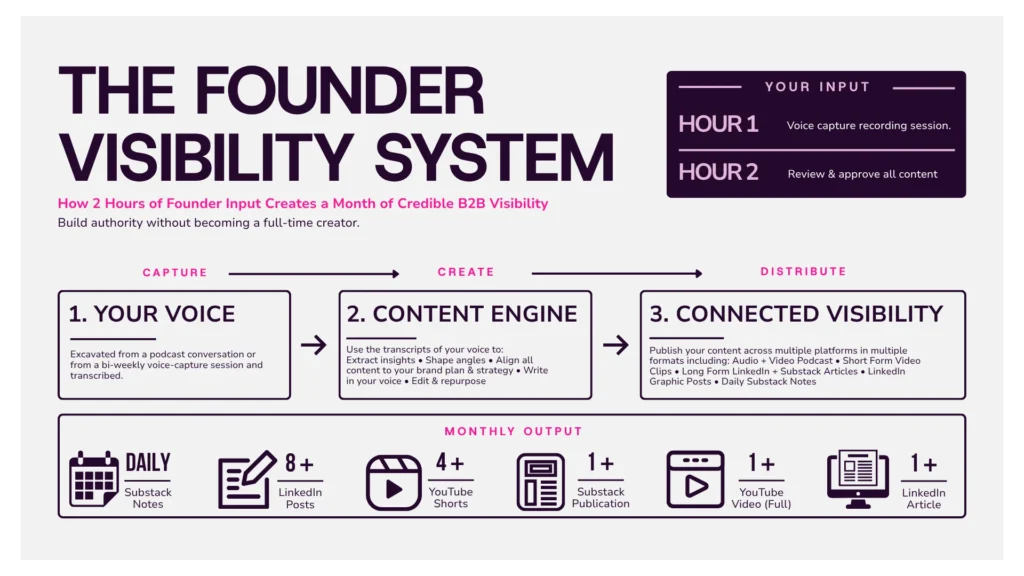
The channel mix and output volume change depending on strategy and goals. Two hours is the executive commitment; the production, distribution and engagement work sits with the system.
The first hour should feel like a focused working conversation, not a content workshop you need to prepare for. Your only job is to bring the experience, opinions and real-world context that already sit inside your day-to-day work.
You do not need a script, a list of topics or a half-finished content calendar.
You also don’t need to know which posts will come out of the session, what format they will take, or how they will be distributed afterwards. What we need from you is the part nobody else can replicate:
This is not an interview where you have to perform, and it is not a session where we ask you to invent thought leadership on the spot. It is a structured conversation designed to uncover the insight already there. We use prompts, follow-up questions and your own language to get beneath the surface-level company messaging and into the experiences that make your perspective credible.
A product page can explain what you do. It cannot explain why you take a different approach, what you have learned after being in the room with clients, or what you believe buyers need to understand before making a decision.
That is where the strongest founder-led content comes from.
Your job in Hour One is simply to talk through what you know.
Our Founder Visibility System captures those conversations, identifies the strongest ideas, and turns them into content that sounds like you – then connects that content across the channels that support your visibility goals.
There is a meaningful difference between content generated from a product page and content captured from a founder’s real experience.
A generic AI-produced post based on a product page will describe features, claim benefits, and sound like every other company in the category. It contains no stories, no earned opinions, no specific buyer language, and no evidence that a human being with relevant experience wrote it.
Content produced from a recorded conversation carries the executive’s actual language, their specific examples, the objections they have heard, and the conclusions they have reached through work. It sounds like the person it represents.
The mechanism that preserves this is what VW calls a Voice Blueprint: a document created during onboarding that captures signature phrases, communication style, core beliefs, red lines, stories, proof points and tone guidance. It means the production team writes in the executive’s voice every time.
Here’s what that difference looks like in practice. Same broad topic. Two very different pieces of content.
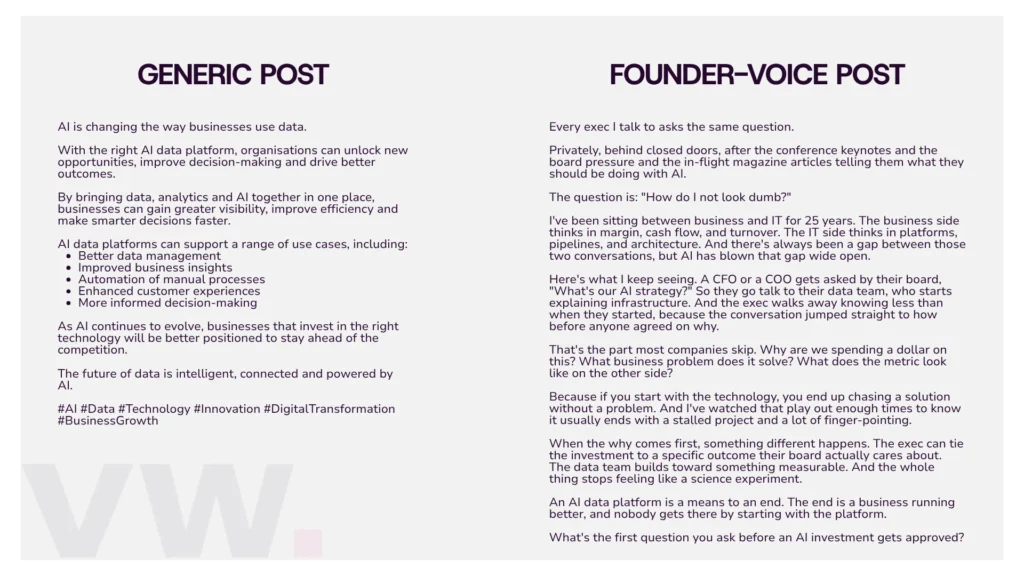
The first post is technically accurate. It covers the right keywords and ticks every box a marketer might put on a brief. Nobody will remember reading it, because it sounds like every other company in the category.
The second post carries something a product page can never produce: a specific scenario buyers recognise, a question they’ve actually asked themselves, and a reframe that changes how they think about the problem. That came from a recorded conversation with a real executive. It sounds like a person because it is one.
The data supports what most readers already feel instinctively. Research across 1.3 million LinkedIn posts found that fully AI-generated content faces up to a 40% drop in reach and a further 25-35% drop in engagement, while content where AI supports the drafting but a human drives the substance shows a dramatically smaller penalty, around 10% on reach (Source: Algorithm Report 2026, Richard van der Blom). The gap between those two numbers is the Voice Blueprint in action.
There’s a misconception around personal brand ROI that comes straight from the social media era. People hear “personal brand” and picture follower counts, likes, viral moments, the whole influencer playbook. So when a founder asks “what’s the return on this?”, they’re often measuring the wrong things entirely.
LinkedIn isn’t social media anymore – it’s interest media. The algorithm doesn’t distribute your content to your followers and hope for the best. It classifies you by topic and routes your content to people interested in that topic, whether they follow you or not. Which means follower count is one of the least useful numbers you could track. A founder with 3,000 relevant followers who are CISOs and IT directors in their buying category is in a stronger commercial position than someone with 30,000 followers who couldn’t name their ICP.
The same applies to likes, impressions, and downloads. A LinkedIn post isn’t just a LinkedIn post. It’s a positioning signal that shapes how a buyer perceives you before they ever pick up the phone. A podcast isn’t a podcast. It’s a relationship-building vessel where every guest is a potential client, partner, or referral, and where the perception of being an industry voice opens doors that cold outreach never could. Speaking invitations, free event tickets, inbound from people you’ve never met, those don’t show up in your post analytics. They show up in your pipeline and your calendar.
When a founder launches a podcast through our system, the ROI isn’t simply measured in downloads alone. It’s measured in how the market now perceives them: as someone worth listening to, worth inviting to speak, worth doing business with. The guest they interviewed in March becomes the client conversation in June, because 45 minutes of genuine dialogue builds more trust than a year of cold emails.
ROI from a founder-led personal brand is not “one post equals one lead.” That is not how B2B buying works. The indicators that the system is working are: relevant ICP contacts entering the pipeline, better-quality inbound conversations, greater buyer familiarity before sales calls, meaningful engagement from the right people, and less friction around pricing.
Here’s what “less friction” looks like in practice:
B2B buyers now complete around 70% of their research before they talk to sales at all (Source: Forrester, cited in The Starr Conspiracy, June 2026). They’re reading content, forming opinions, and building a shortlist while the founder sleeps.
When a prospect has already encountered a founder’s thinking through content, the sales conversation changes. They’re not starting from “tell me what you do.” They’re starting from “I’ve read your take on X, we’re dealing with something similar.” That’s not a cold meeting. That’s a warm conversation with someone who already understands how you think.
Less friction means the prospect arrives with familiarity. They’ve seen how the founder frames problems. They’ve read a perspective that resonated. They may have saved a post or shared it with a colleague. By the time they book a call, they’re not evaluating whether you’re credible. They’ve already decided you are. The conversation moves straight to whether you’re the right fit for their specific situation.
Content alone doesn’t guarantee that outcome. The offer, sales process, timing and follow-up all play a role. But a founder who has been consistently visible in the spaces where their buyers research is starting those conversations from a fundamentally different position than one who hasn’t.
Visibility Wins delivers Executive Brand Management for B2B technology founders, CEOs and senior leaders across the UK and Ireland. The managed system covers brand planning, voice capture, ongoing content production, engagement activity and monthly reporting. LinkedIn is the core channel; podcast, YouTube and Substack are available according to tier and fit.
Be the Authority your buyers think of first
A well-designed system requires roughly two focused hours a month from the founder: one hour to capture insight through a structured conversation, and one hour to review and approve content. The production, distribution and engagement work sits with the system, not the founder’s calendar.
Fully AI-generated content tends to underperform. Research across 1.3 million LinkedIn posts found it faces up to a 40% drop in reach and a further 25-35% drop in engagement. AI-assisted content rooted in a founder’s real experience, language and perspective performs far better, because the platform and its readers respond to human signals.
Not by follower counts, likes or impressions. The meaningful indicators are relevant ICP contacts entering the pipeline, better-quality inbound conversations, greater buyer familiarity before sales calls, speaking invitations, and less friction around pricing. Personal branding shapes how buyers perceive you before sales gets involved, which shows up in pipeline quality rather than post analytics.
A Voice Blueprint is a document created during onboarding that captures a founder’s signature phrases, communication style, core beliefs, red lines, stories, proof points and tone. It’s what allows a production team to write content that sounds like the executive rather than a generic brand voice.

Digital Marketing Manager, Visibility Wins
Matthew Sloan is a B2B marketer specialising in personal branding and creative-led growth for technology and cybersecurity companies. At Visibility Wins, he leads marketing strategy and execution, delivering campaigns that balance commercial performance with distinctive positioning. His work spans content, design, and demand generation, with a focus on helping technical experts build credible, visible brands. Matthew also plays a key role in developing and delivering podcast-led marketing programmes, turning subject matter expertise into consistent audience engagement. Known for blending creative thinking with practical execution, he supports both clients and internal teams in shaping strategies that cut through and convert.